Broken Tip or Chipped Knife? Here Is How a Pro Sharpener Can Fix It
Updated: Sep 18
That little chip in your chef’s knife looks harmless until it catches on an onion skin, tears through herbs, or leaves a ragged edge on a tomato. A broken tip is even more annoying. One day you’re trimming silver skin or coring a strawberry, and suddenly the knife feels clumsy.

If this were my knife, I wouldn’t toss it. I also wouldn’t attack it with a pull-through sharpener and hope for the best. A chipped knife or broken tip can usually be fixed, as long as there’s enough steel left and the blade isn’t cracked through.
Most of the time, you don’t need a new knife. You need a better edge, shaped by someone who knows how to remove damaged steel without ruining the blade.

What actually happens when a knife chips
A chip means a piece of steel is gone from the cutting edge. That sounds obvious, but it matters because you can’t “fill in” a chip. The repair has to bring the rest of the edge down to meet the deepest part of the damage.
Think of the edge like a roof peak. Both sides of the blade slope down until they meet at a very thin line. If a chunk breaks out of that line, the whole edge needs to be reshaped so it meets cleanly again.
Common causes include:
Twisting the knife while cutting hard squash or frozen food
Hitting bone, pits, or hard seeds
Dropping the knife in the sink
Cutting on glass, stone, or ceramic boards
Tossing knives loose into a drawer
Using a thin Japanese-style blade for rough utility work
Harder steels often hold an edge longer, but they can be less forgiving under side pressure. Softer steels may roll instead of chip. Neither is “bad.” They just fail in different ways.
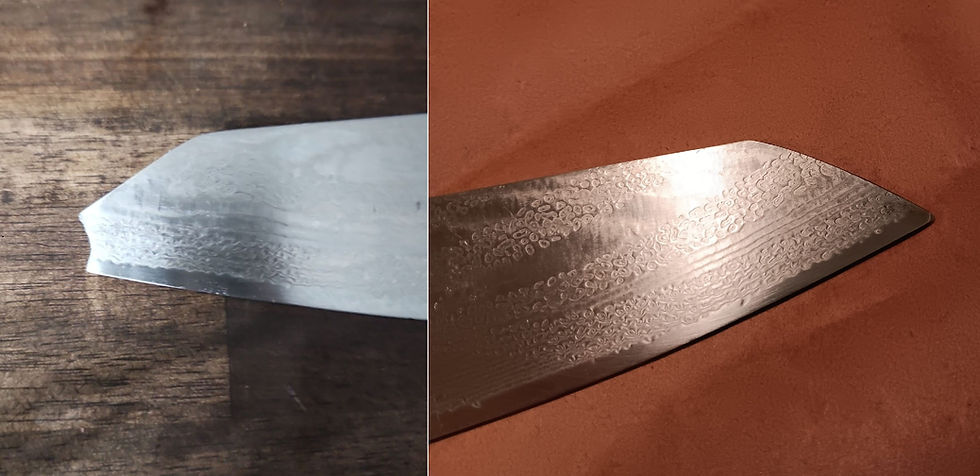
A broken tip works the same way. The missing piece isn’t coming back, so the profile has to be rebuilt with the blade you still have.
Why a pro sharpener handles chips differently
Regular knife sharpening is about refreshing an edge. Chip repair is more involved. A professional sharpener has to remove damage, protect the blade’s shape, and keep the knife useful for the way it was designed to cut.
That usually means three things.
The chip has to be ground out evenly.
If only one small area gets ground down, the edge can develop a dip or recurve. That dip will skip over food and make board contact worse.
The blade may need thinning.
When a lot of steel comes off the edge, the knife gets thicker behind the edge. If it isn’t thinned, it may feel sharp at first but wedge through carrots, potatoes, and apples. Thinning keeps the knife cutting smoothly instead of forcing food apart.
The original profile should be protected.
A chef’s knife needs a gentle curve for rocking. A santoku usually wants a flatter section for chopping. A paring knife needs a precise tip. The repair should respect that shape as much as possible.
This is where experience matters. A pro isn’t just making the damaged spot shiny. They’re deciding how much metal to remove, where to blend it, and how to finish the edge so the knife feels normal again.

How a broken tip gets rebuilt
A broken tip can be repaired a couple of different ways. The right choice depends on the knife.
One method is to bring the spine down to meet the edge. That keeps more of the cutting edge intact, but it slightly changes the look of the spine near the tip. This is often a good choice when the break is small.
Another method is to bring the edge up toward the spine. That can preserve the top line, but it removes more cutting edge and may shorten the blade’s usable length.
Sometimes the repair uses a little of both. The goal is simple: create a strong, useful tip that lines up with the knife’s geometry.
For a home chef, the difference shows up in daily prep. A repaired tip should still slide under onion skin, trim fat, score dough, and make small detail cuts. It may be a tiny bit shorter than before, but it shouldn’t feel blunt or awkward.
That’s the part that’s easy to miss with DIY repairs. A grinder can create a point. A professional knife repair should create a working tip.
Why DIY chip repair can go wrong fast
There’s nothing wrong with maintaining knives at home. A ceramic honing rod, a strop, or water stones can keep a good edge going for a long time. But fixing chips is a different job.
The main risk is removing too much steel in the wrong place.
Pull-through sharpeners can make the problem worse because they scrape metal aggressively and don’t follow every knife’s original angle well. Coarse stones can work, but only if you know how to keep the bevel even and blend the whole edge. Bench grinders are especially risky because excess heat can damage the steel’s temper. Once the very edge overheats, it may not hold sharpness the same way.
There’s also a safety issue. A chipped edge can catch and jump during a cut. A broken tip can glance off food instead of entering cleanly. That’s when a knife starts feeling unpredictable.
Here in Brevard County, a lot of kitchen knives also deal with humidity, salty air, outdoor cooking, and sink-side storage. None of that helps an already damaged edge. If the knife has sentimental value, or if it’s one you reach for every night, it’s worth fixing properly.
When the knife is worth fixing
Most chipped knives are worth saving if the handle is solid and the blade isn’t deeply cracked. A good repair can bring back a knife that looked done.
It’s usually worth fixing when:
The chip is small or medium depth
The tip is broken but not far back into the blade
The knife feels good in your hand
The handle is secure
The blade has enough height left to reshape
Replacing it would cost more than repairing it
There are times when replacement makes more sense. If the blade has a crack running up from the edge, if the handle is loose and unsafe, or if a cheap knife has severe damage across much of the edge, repair might not be the best use of money.
But don’t assume a chip means the knife is finished. I’ve seen plenty of knives come in looking rough and leave ready for dinner prep again.
What the finished knife should feel like
After repair, the edge should feel smooth from heel to tip. It shouldn’t snag on paper, herbs, or tomato skin. The repaired section should blend into the rest of the blade, not feel like a flat spot or sudden bump.
A properly fixed knife should also be thin enough behind the edge to cut well. Sharpness isn’t just about the final apex. Geometry matters. That’s why two knives can both shave hair, but only one glides through a sweet potato without cracking it apart.
A good repair leaves you with a knife that feels familiar, just cleaner and safer.

Take the chip seriously, but don’t panic
A broken tip or chipped edge looks worse than it usually is. The fix is controlled steel removal, careful reshaping, thinning when needed, and a clean final edge.
That’s why taking it to a professional sharpener makes sense. We have the tools to repair the damage without chewing up the knife, and we know how to keep the blade’s profile close to what made it useful in the first place.
So if your favorite knife has a chip, don’t retire it to the junk drawer yet. Get the edge fixed, treat it a little better, and put it back to work.


Comments